
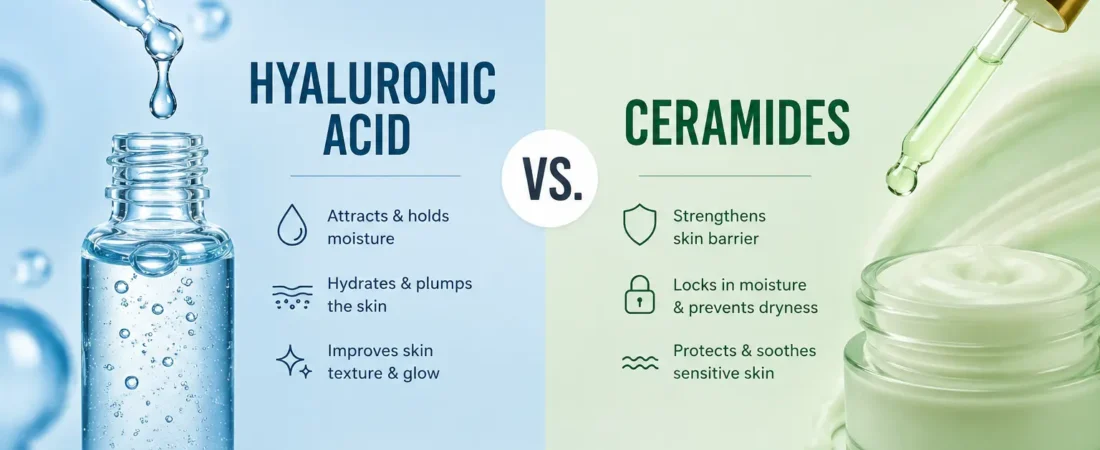
If you’ve spent even five minutes browsing skincare products, you’ve probably seen two ingredients everywhere: ceramides and hyaluronic acid. One promises intense hydration, while the other claims to strengthen your skin barrier. Both sound essential—but do you actually need both?
The answer isn’t as simple as choosing one over the other.
In reality, these two ingredients solve different problems, and understanding how they work can completely change the way you approach skincare. Instead of buying products because they’re trending, you’ll know exactly what your skin is asking for.
Let’s break it down.
First Things First: Your Skin Doesn’t Need “More Products”—It Needs the Right Ones
One of the biggest misconceptions in skincare is that more products automatically lead to healthier skin. In reality, healthy skin depends on balance.
Imagine your skin as a brick wall.
- The skin cells are the bricks.
- The ceramides are the cement holding those bricks together.
- The water inside your skin keeps the wall strong and flexible.
Now imagine that wall starting to crack. Water begins escaping, irritants sneak inside, and suddenly your skin feels dry, sensitive, or inflamed.
This is where ceramides and hyaluronic acid come in—but they work in completely different ways.
What Are Ceramides?
Ceramides are naturally occurring lipids (fats) that make up nearly half of your skin’s protective barrier.
Think of them as your skin’s security system.
Their main job is to:
- Lock moisture inside the skin
- Protect against pollution and bacteria
- Prevent excessive water loss
- Reduce irritation
- Keep the skin barrier healthy
Unfortunately, ceramide levels naturally decrease with age. They’re also reduced by:
- Over-exfoliating
- Harsh cleansers
- Retinoids (especially when overused)
- Sun damage
- Cold weather
- Certain skin conditions like eczema
When your ceramide levels drop, your skin often feels:
- Tight after cleansing
- Dry even after moisturizing
- Easily irritated
- Red and inflamed
- Rough or flaky
In other words, your skin barrier starts struggling to do its job.
What Is Hyaluronic Acid?
Despite its intimidating name, hyaluronic acid isn’t an exfoliating acid.
It’s actually a powerful humectant, meaning it attracts and holds water.
One molecule of hyaluronic acid can bind an impressive amount of water, helping your skin appear:
- Plumper
- Softer
- Smoother
- More hydrated
Your body naturally produces hyaluronic acid, but like ceramides, production declines over time.
Environmental stress, aging, and dehydration can all reduce the amount your skin naturally contains.
Unlike ceramides, however, hyaluronic acid doesn’t repair the skin barrier.
Its job is much simpler—it helps increase your skin’s water content.
The Biggest Difference
This is where many people get confused.
Both ingredients help dry skin, but they do it differently.
Hyaluronic Acid
- Adds hydration
- Attracts water
- Gives temporary plumpness
- Makes fine dehydration lines less noticeable
Ceramides
- Seal hydration inside
- Repair the skin barrier
- Reduce moisture loss
- Improve long-term skin health
Think about it this way:
Hyaluronic acid fills the water bottle.
Ceramides put the lid on it.
Without the lid, the water eventually disappears.
Which Ingredient Is Better for Dry Skin?
If your skin constantly feels dry, flaky, or uncomfortable, ceramides are usually the bigger priority. Dry skin isn’t always caused by a lack of water. More often, it’s caused by a damaged barrier that can’t hold onto moisture.
Adding hyaluronic acid without repairing the barrier is a bit like pouring water into a bucket with holes. The hydration doesn’t stay where it’s needs to.
When Should You Choose Hyaluronic Acid?
Hyaluronic acid is an excellent choice if your skin feels:
- Dehydrated
- Dull
- Tight
- Tired-looking
- Less plump than usual
This often happens because of:
- Air conditioning
- Long flights
- Hot weather
- Not drinking enough fluids
- Seasonal changes
Hydration can make your skin look healthier within days, which is why hyaluronic acid remains one of the most popular skincare ingredients.
When Are Ceramides the Better Choice?
Ceramides become especially important if you:
- Use retinol
- Use chemical exfoliants
- Have eczema
- Have sensitive skin
- Experience redness often
- Overused active ingredients
- Have a compromised skin barrier
Signs you need ceramides include:
✓ Burning after applying skincare
✓ Skin feels dry no matter what moisturizer you use
✓ Constant redness
✓ Peeling
✓ Tightness after cleansing
✓ Increased sensitivity
These are all classic signs your skin barrier needs support.
Can You Use Ceramides and Hyaluronic Acid Together?
Absolutely.
In fact, this is where they work best. Hyaluronic acid brings water into the skin.
Ceramides help keep that hydration locked in. Together, they create healthier, longer-lasting hydration than either ingredient alone.
This is why many dermatologist-recommended moisturizers include both.
Which Should You Apply First?
The order is simple.
- Cleanser
- Hyaluronic acid serum (on slightly damp skin)
- Ceramide moisturizer
- Sunscreen (morning)
At night:
- Cleanser
- Treatment serum (if using one)
- Hyaluronic acid
- Ceramide moisturizer
Applying hyaluronic acid to slightly damp skin helps it bind available moisture more effectively. Following with a ceramide-rich moisturizer helps reduce water loss.
What About Oily Skin?
Many people with oily skin avoid moisturizing because they’re worried it will make their skin even oilier.
Ironically, the opposite can happen. When your skin barrier is compromised, your skin may produce more oil to compensate.
Lightweight ceramide moisturizers can actually help restore balance without feeling greasy.
Likewise, hyaluronic acid provides hydration without adding oil, making it suitable for most oily and combination skin types.
Common Myths Worth Clearing Up
“Ceramides are only for dry skin.”
Not true.
Every skin type has a skin barrier, including oily skin. Healthy ceramide levels benefit everyone.
“Hyaluronic acid replaces moisturizer.”
It doesn’t.
A humectant attracts water, but it still needs a moisturizer to help keep that hydration in place.
“You have to choose one.”
You don’t.
Most people benefit from using both, especially if their goal is healthy, resilient skin rather than just a temporary glow.
How to Choose Based on Your Skin’s Needs
| Your Concern | Best Choice |
|---|---|
| Tight, dehydrated skin | Hyaluronic acid |
| Flaky, damaged skin barrier | Ceramides |
| Redness and irritation | Ceramides |
| Dull-looking skin | Hyaluronic acid |
| Using retinol | Ceramides |
| Sensitive skin | Ceramides |
| Fine dehydration lines | Hyaluronic acid |
| Healthy, balanced skin | Both together |
The Bottom Line
If skincare had a “dream team,” ceramides and hyaluronic acid would be on it.
One ingredient helps your skin hold onto water, while the other helps bring that water in. They aren’t competitors—they’re partners.
If your skin feels dehydrated, hyaluronic acid can provide an instant boost. If your skin is constantly dry, irritated, or struggling to recover, ceramides may be exactly what it’s been missing.
The healthiest skin isn’t built by chasing every trending ingredient. It’s built by understanding what your skin needs and giving it consistent, gentle support.
Sometimes, the smartest skincare routine isn’t the one with the most products—it’s the one where every ingredient has a purpose.