
If your face keeps turning red, the answer may not be another “calming” serum.
Redness is one of those skincare problems that encourages overcorrection. You see red cheeks, so you exfoliate. Your skin feels rough, so you add an acid. It still looks irritated, so you buy a soothing mask.
Then your skin starts stinging when you apply products that never used to bother you.
Sound familiar? Here’s the more useful way to approach facial redness:
Don’t treat redness as the problem until you’ve worked out what is causing it.
Redness can be linked to irritation, environmental triggers, acne, contact reactions, or conditions such as rosacea and eczema. The right approach depends on the pattern you’re seeing.
This guide breaks down how to reduce facial redness without turning your skincare routine into an experiment with 12 different products.
Quick Answer: How Do You Reduce Facial Redness?
To reduce facial redness, start by identifying and removing potential irritants, simplify your skincare routine, use a gentle cleanser and moisturizer, protect your skin from UV exposure, and avoid excessive heat, friction, and exfoliation.
If redness is persistent, recurrent, or accompanied by burning, bumps, swelling, or eye symptoms, see a dermatologist rather than repeatedly changing products.
That’s the short version.
The interesting part is figuring out which of these actually applies to your skin.
Why Is Your Face Red in the First Place?
Not all facial redness behaves the same way.
A face that becomes temporarily flushed after exercise is different from skin that stays red throughout the day. Redness that appears immediately after applying a new product is different again.
Some common possibilities include:
1. Your skincare routine is irritating your skin
A product doesn’t have to be objectively “bad” to irritate your skin.
You may simply be using too many potentially irritating products—or using a product too frequently.
This becomes especially relevant when your routine contains several exfoliating or treatment products.
2. Your skin barrier is stressed
Redness accompanied by tightness, dryness, flaking, burning, or increased sensitivity can be a sign that your skin is struggling to tolerate your routine.
When even your moisturizer suddenly stings, that’s a useful signal to stop adding more treatments and reassess.
3. You’re reacting to an ingredient
Contact dermatitis can occur when something touching your skin causes irritation or an allergic reaction. Fragrance is one possible trigger, but reactions can have many causes.
And importantly, a product you’ve used for a long time isn’t automatically ruled out.
4. Your environment is triggering flushing
Heat, sun exposure, wind, cold, and other environmental factors can aggravate redness-prone skin. For people with rosacea, identifying individual triggers is an important part of management.
5. There may be an underlying skin condition
Persistent redness can occur with conditions including rosacea, eczema, seborrheic dermatitis, and contact dermatitis.
That’s why “just use a calming serum” isn’t always good advice.
The Redness Audit: A 60-Second Way to Understand Your Skin
Before changing your routine, ask yourself five questions:
When does the redness appear?
Where does it appear?
How long does it last?
What happens immediately before it appears?
Does your skin sting, burn, itch, flake, or develop bumps?
Those answers can be more useful than simply deciding that you have “sensitive skin.”
If Your Skin Turns Red Immediately After Skincare
Look at what changed.
Did you recently introduce:
- An exfoliating acid?
- A retinoid?
- A new cleanser?
- A fragrance-heavy product?
- Several new products at once?
- A product that makes your skin burn or sting?
Don’t assume that more tingling means the product is working.
Tingling is not a skincare success metric.
If a product repeatedly causes burning, stinging, itching, or obvious irritation, stop and reassess rather than trying to “push through.”
If Your Skin Is Red, Tight and Flaky: Simplify First
This is where many skincare routines go in the wrong direction.
You notice texture.
You exfoliate.
The texture looks worse.
You exfoliate again.
Now your skin is dry, tight, and red.
Instead of adding another treatment, temporarily reduce your routine to the essentials.
Morning
- Cleanse gently—or simply rinse if your skin doesn’t need a morning cleanse.
- Moisturize.
- Apply broad-spectrum sunscreen.
Evening
- Cleanse gently.
- Moisturize.
That’s your baseline.
The goal isn’t to create a perfect routine overnight. It’s to create a routine your skin can comfortably tolerate.
Should You Stop Exfoliating When Your Face Is Red?
If your skin is actively irritated, reducing or pausing exfoliation is a sensible step.
Physical scrubs, exfoliating tools, and frequent acids can add irritation to already-sensitive skin.
The American Academy of Dermatology specifically advises people with rosacea-prone skin to avoid rubbing, scrubbing, washcloths, facial sponges, and exfoliators because irritation can worsen symptoms.
That doesn’t mean everyone must permanently avoid exfoliation.
It means don’t use exfoliation as your first response to irritated skin.
What Ingredients Are Best for Red, Sensitive Skin?
Here’s where skincare advice often becomes too ingredient-obsessed.
Instead of asking: “What is the best ingredient for redness?”
Ask: “What can my skin comfortably tolerate?”
A simple moisturizer may contain ingredients such as ceramides, glycerin, humectants, and emollients that support hydration and the skin barrier.
But you don’t need to buy a product just because one ingredient is trending.
A basic moisturizer that your skin tolerates consistently can be more useful than an elaborate formula that makes your face sting.
For rosacea-prone skin specifically, the AAD recommends choosing gentle, fragrance-free products and testing products before applying them broadly.
The Sunscreen Rule for Redness-Prone Skin
If facial redness is a concern, sunscreen shouldn’t be an afterthought.
UV exposure can aggravate rosacea and other forms of skin irritation. The AAD recommends broad-spectrum sunscreen with SPF 30 or higher for people managing rosacea, alongside other sun-protection measures.
If sunscreen itself feels irritating, don’t conclude that sun protection isn’t for you.
Instead, look for a formulation your skin tolerates.
Your Shower Could Be Making Your Redness More Noticeable
If your face looks dramatically red after a hot shower, experiment with cooler, lukewarm water.
Also rethink the way you dry your face. You don’t need to scrub your skin dry.
Gently patting it with a clean towel reduces unnecessary friction.
This sounds almost too simple—but when skin is already irritated, removing small sources of irritation adds up.
Don’t Blame Every Red Face on “Sensitive Skin”
This deserves its own section.
“Sensitive skin” is often used as a catch-all explanation for almost anything involving redness.
But persistent redness can have different causes.
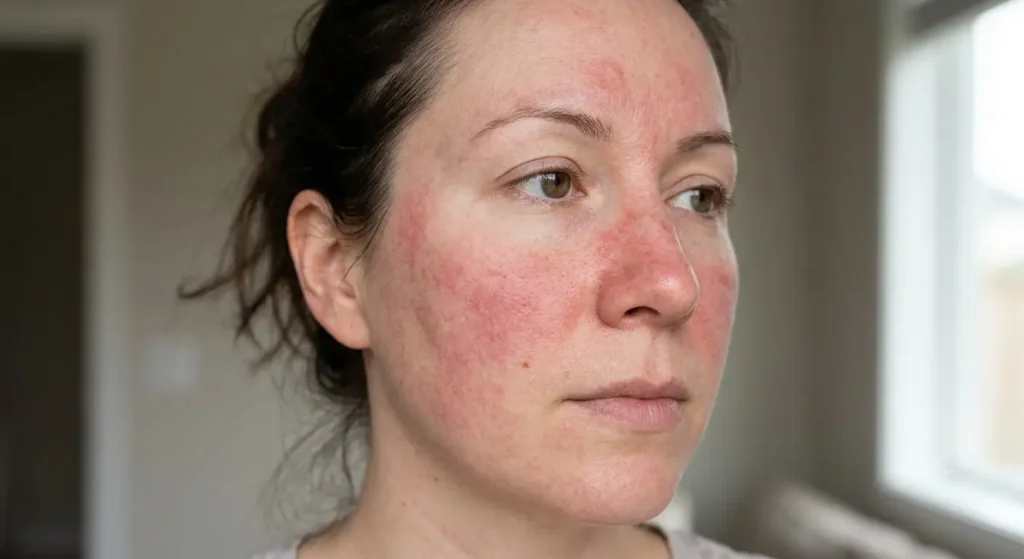
For example, rosacea commonly involves flushing or redness in the center of the face and can also involve sensitivity, burning or stinging, visible blood vessels, and acne-like breakouts.
That doesn’t mean every red cheek is rosacea.
It means persistent redness deserves more thought than simply buying sensitive-skin products.